
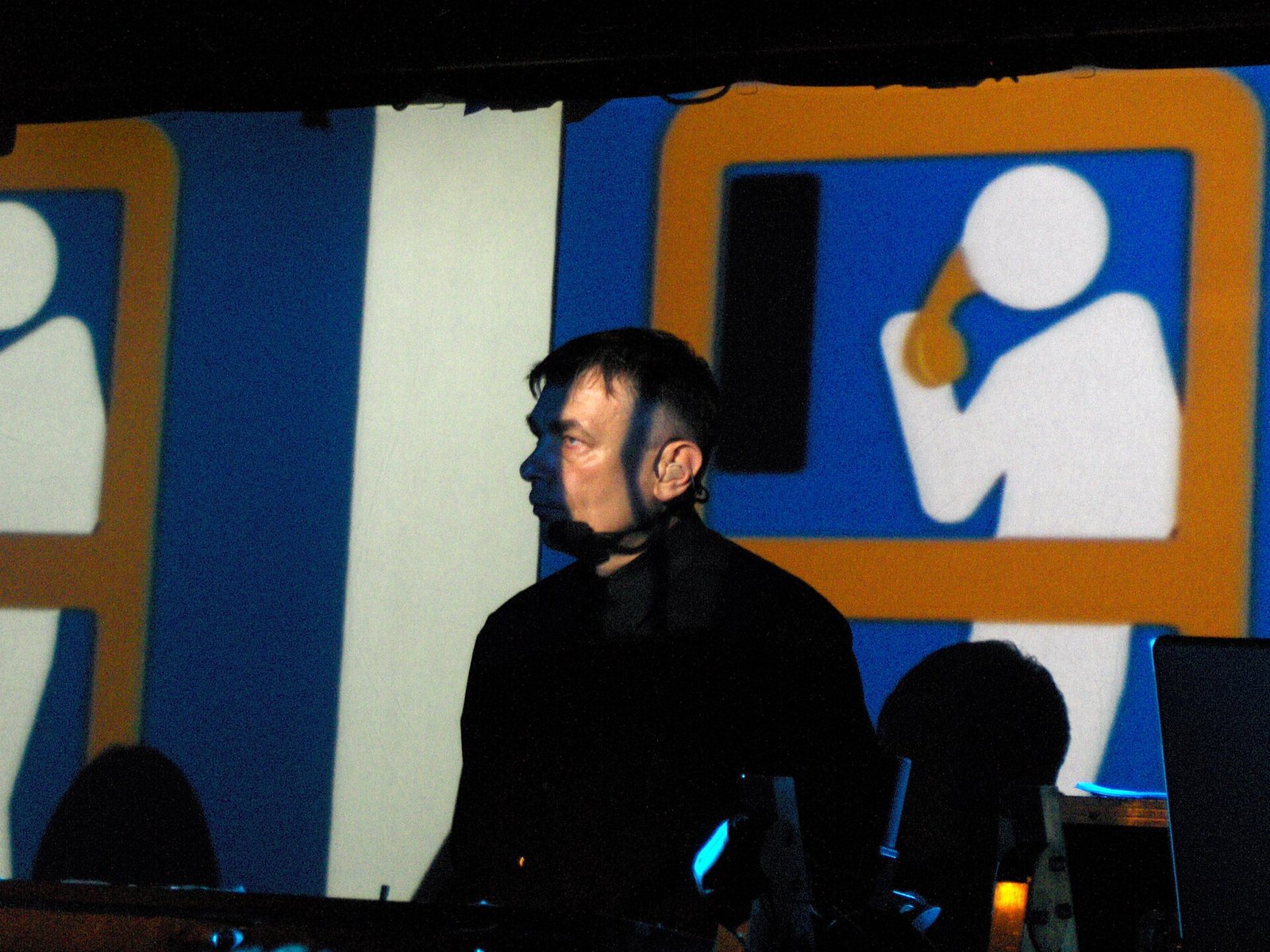
Karl Bartos, who played electronic drums in Kraftwerk from 1975 to 1990, says the computer ended the way the band made music. “In the beginning we often called our studio an electronic garden, but that garden developed into a factory farming industry,” he told MusicRadar.
The interview, recorded at his studio in Hamburg a couple of years ago, was republished in full on 12 October for the magazine’s Recording Week.
“When we wrote Computer World we were still human beings playing together,” Bartos said. “The computer came and turned us into a musical box.”
Digital gear arrived with Electric Café
Computer World came out on 11 May 1981. For an album about computers, the kit was basic: “We had a Moog synth, an ARP synth and a 16-step sequencer but we had the image in our head,” he said, comparing it to William Gibson’s Neuromancer, a novel about cyberspace “written on a typewriter”.
The sequencer was a Friend-Chip “Mr. Lab”, the Music and Rhythm Laboratory, and the band also used a Synthanorma sequencer around that time, MusicRadar noted.
The band’s next album, Electric Café, released on 27 October 1986, was the first Kraftwerk record made mostly with digital instruments.
“The turning point for us was digitalisation, and when Kraftwerk became an institution we stopped being contemporary,” Bartos said. “Instead we became salesmen of nostalgia.”
“The idea was that the computer would give us more time for creativity, but it was just the opposite,” he added. “The human beings were not at the centre of everything, the computer was. And we were serving the computer industry.”
He also wrote the beat of “Numbers”, which Afrika Bambaataa used on “Planet Rock” in 1982.
He left Kraftwerk in August 1990. “Some of my partners in Kraftwerk believed so much that it was progress, but I actually couldn’t follow that,” he said. “I think innovation and progress are not synonyms.”
The only Kraftwerk song he sang
Electric Café also holds the one Kraftwerk song with Bartos on lead vocals, “The Telephone Call”. Released in 1987 as the album’s second and last single, it spent two weeks at No. 1 on Billboard’s dance club chart.
In the video the silhouetted singer looks like Bartos, but when the camera pans round it turns out to be Wolfgang Flür.
He is no fan of AI in music either. “It’s overestimated, I think. It’s just an archive of human logic,” he said, calling it “a wet dream from some of those guys in Silicon Valley.”
His own method avoids recording ideas at all. He sings over a guitar, writes nothing down and waits to see what he remembers the next day: “If you can’t remember, then forget it.”
He still owns two Minimoogs, a Polymoog, an ARP Odyssey, a Korg MS-20, a Roland TB-303 and a Yamaha DX7. The Polymoog, “still working”, made a lot of the music on his 2024 soundtrack to the silent film The Cabinet of Dr. Caligari.
That album came out on Bureau B on 16 February 2024. He made it with the engineer Mathias Black, who worked from Düsseldorf over FaceTime and a cloud server while Bartos stayed in Hamburg.
Outside Kraftwerk he worked with Bernard Sumner and Johnny Marr on Electronic’s 1996 album Raise the Pressure. He was in Kraftwerk for “Metall auf Metall”, the 1977 track behind the band’s 27-year court fight over a two-second drum sample. For more synth history, see how The Human League made Dare and how Moroder built I Feel Love.
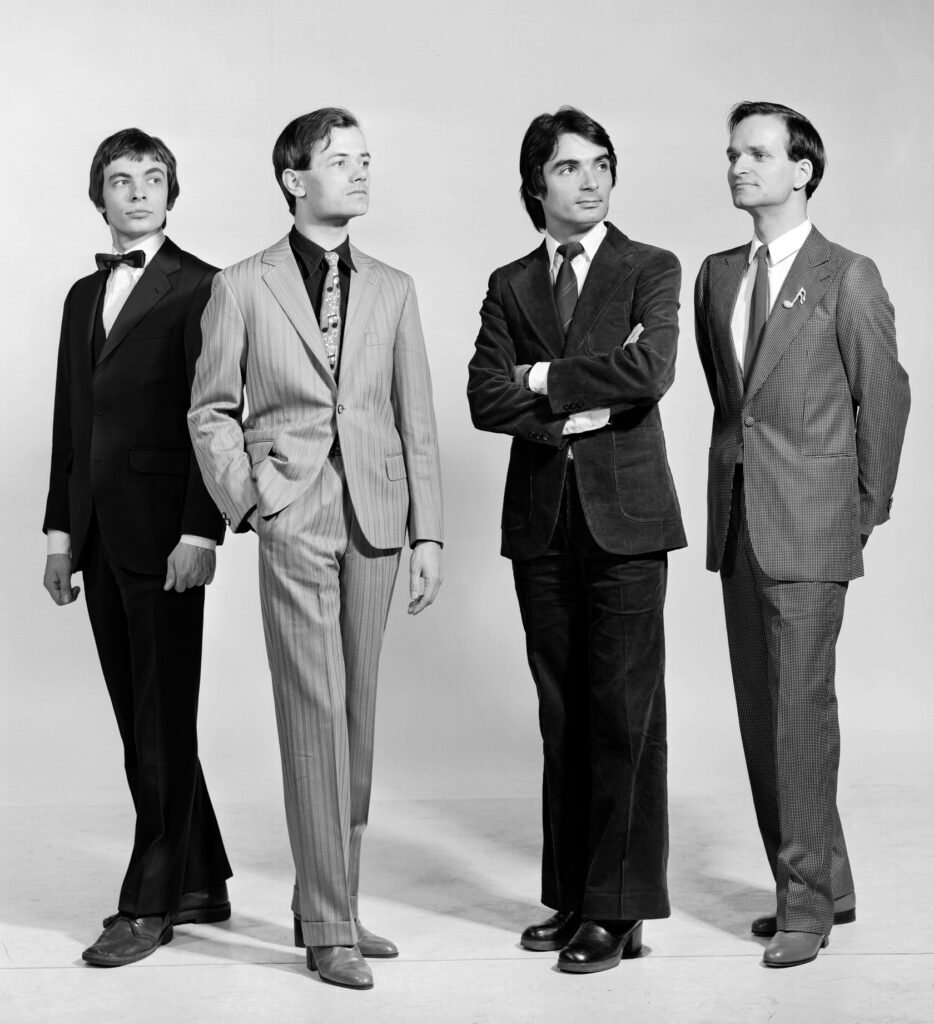
Bartos, born on 31 May 1952, was named on 12 May 2021 as an inductee of the Rock and Roll Hall of Fame, with Ralf Hütter, Florian Schneider and Wolfgang Flür, the four-man line-up that made Computer World.
Lead photo: Jørgen Hans Maltesen / Wikimedia Commons, CC BY-SA 3.0