
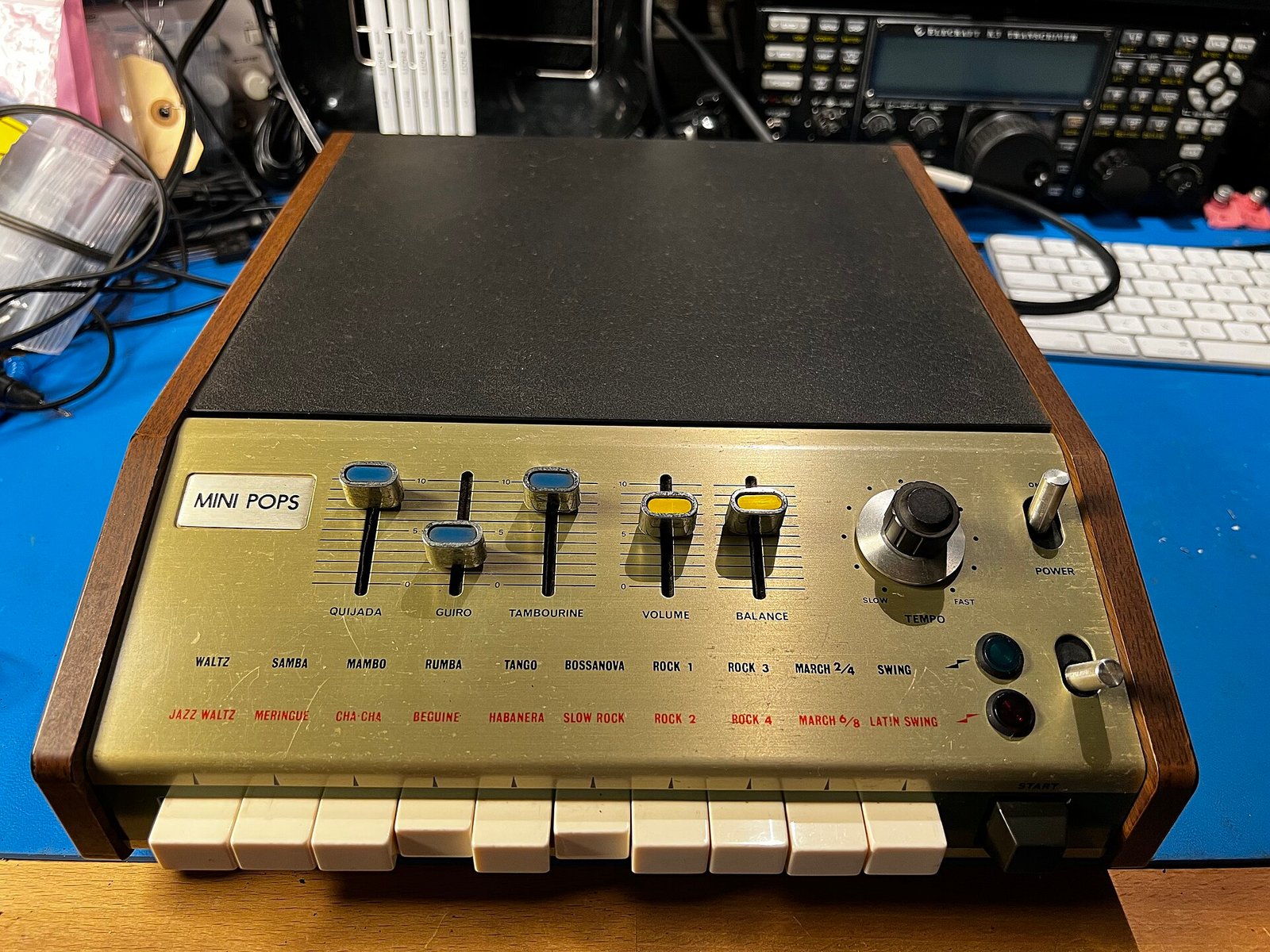
Behringer has released the Mini Pops 7, an analogue copy of the Korg rhythm box Jean-Michel Jarre used on Oxygène in 1976. UK shop Andertons lists it at £149.
The original came out in 1966 from Keio Electronic Laboratories, the Tokyo firm that became Korg. Of all the Mini Pops models it was the most used. It had no sequencer, just 20 preset rhythms from waltz and samba to tango and slow rock, picked with a row of piano-style keys.
What Behringer changed
The clone has 13 analogue drum sounds, each with variants, plus a mix control. Two of them, the quijada and guiro, can be tuned in pitch and level, and on the 1966 box they were a jawbone rattle and a scraped gourd for the Latin rhythms.
Unlike the original, it has a 16-step sequencer with lit step buttons. You can switch between 32 patterns as it plays and chain them into songs up to 250 bars long.
Behringer added nine separate analogue outputs, so each drum can be recorded on its own track, and a distortion circuit, modelled on the RAT guitar pedal, with its own tone and level knobs.
There are 13 knobs and 24 switches on the panel, along with 5-pin MIDI, a USB-C port, a sync input, a pedal input and a headphone socket.
The case is the same small desktop format as Behringer’s RD-6 and RD-78 drum machines.
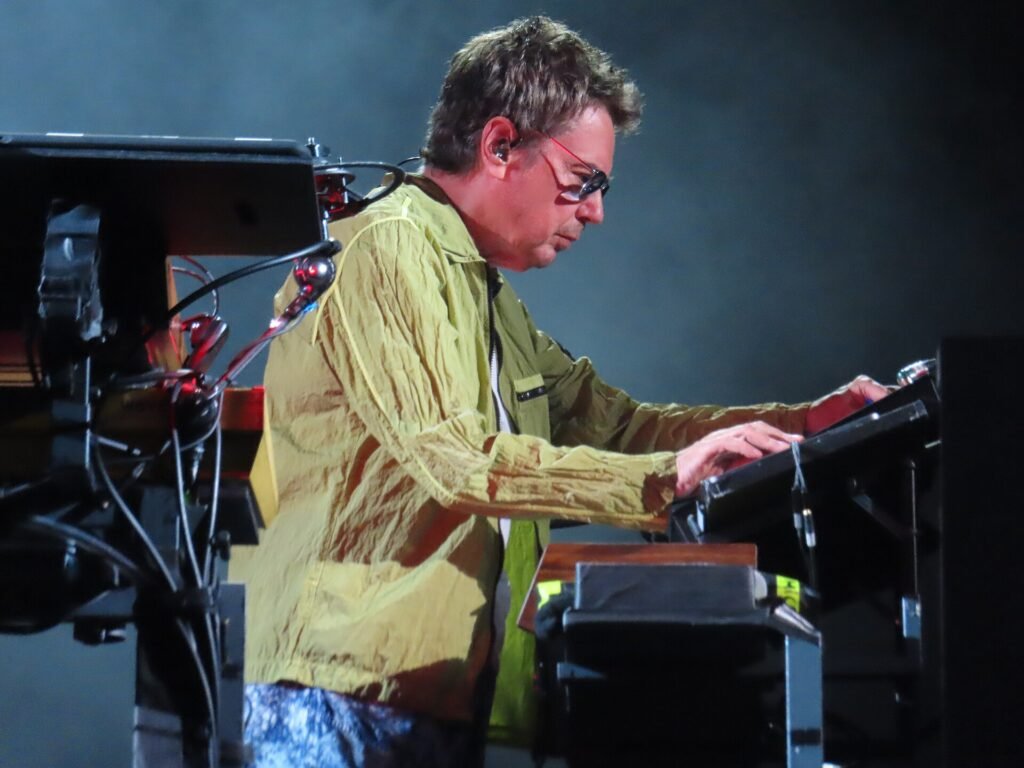
Behringer first teased the clone in 2024, according to MusicTech. It then turned up in the company’s Synthtribe software, and US shop Sweetwater opened pre-orders at $229 in August, before Behringer had put it on its own website.
In Australia, the distributor Australis Music announced it last week, with stock due in early February 2027.
Sticky tape on Oxygène
Jarre recorded Oxygène in 1976 with an ARP 2600, an EMS VCS3 and a Korg Mini-Pops 7. Because the box could only play its presets, he held two rhythm keys down at once with adhesive tape.
“Oxygène (Part IV)” runs the “rock” and “slow rock” rhythms together, and “Part VI” mixes “rhumba” with “bossa nova”.
Disques Motors released the album in France in December 1976, sending the first 50,000 copies to hi-fi shops to demonstrate stereo systems. It has sold an estimated 18 million copies. Jarre went back to the machine for Equinoxe in 1978, where Parts V to VII use its Rock 1 pattern.
Aphex Twin named the opening track of Syro “minipops 67”, with “120.2” in square brackets after it. The album came out on Warp in September 2014 and won the Grammy for Best Dance/Electronic Album in February 2015.
Echo and the Bunnymen used a Mini-Pops 7 early on, and a Minipops Junior keeps time on “The Pictures on My Wall”, their first single, pressed in a run of 4,000 copies in May 1979.
In the US a variant was sold as the Univox SR-95, with slightly different “Beguine” and “Slow Rock” rhythms and no rimshot.
Korg started with a rhythm machine
Keio was founded in 1962 by Tsutomu Kato and Tadashi Osanai, and its first product was the Donca-Matic DA-20 rhythm machine of 1963. Osanai, an accordionist, built it because he disliked the Wurlitzer Sideman that backed him at Kato’s club. The name Keio came from the Keio train line near its offices and from the first letters of the founders’ surnames.
Behringer has already copied the Roland TR-808 and the Juno-60. A leak in May listed a clone of the Yamaha CS-80, the synth whose Vangelis-owned example sold for £401,465.
The 50th anniversary edition of Oxygène, remastered from the 1976 tapes and mixed again in Dolby Atmos, comes out on 20 November.
Lead photo: Alison Cassidy / Wikimedia Commons, CC BY-SA 4.0