
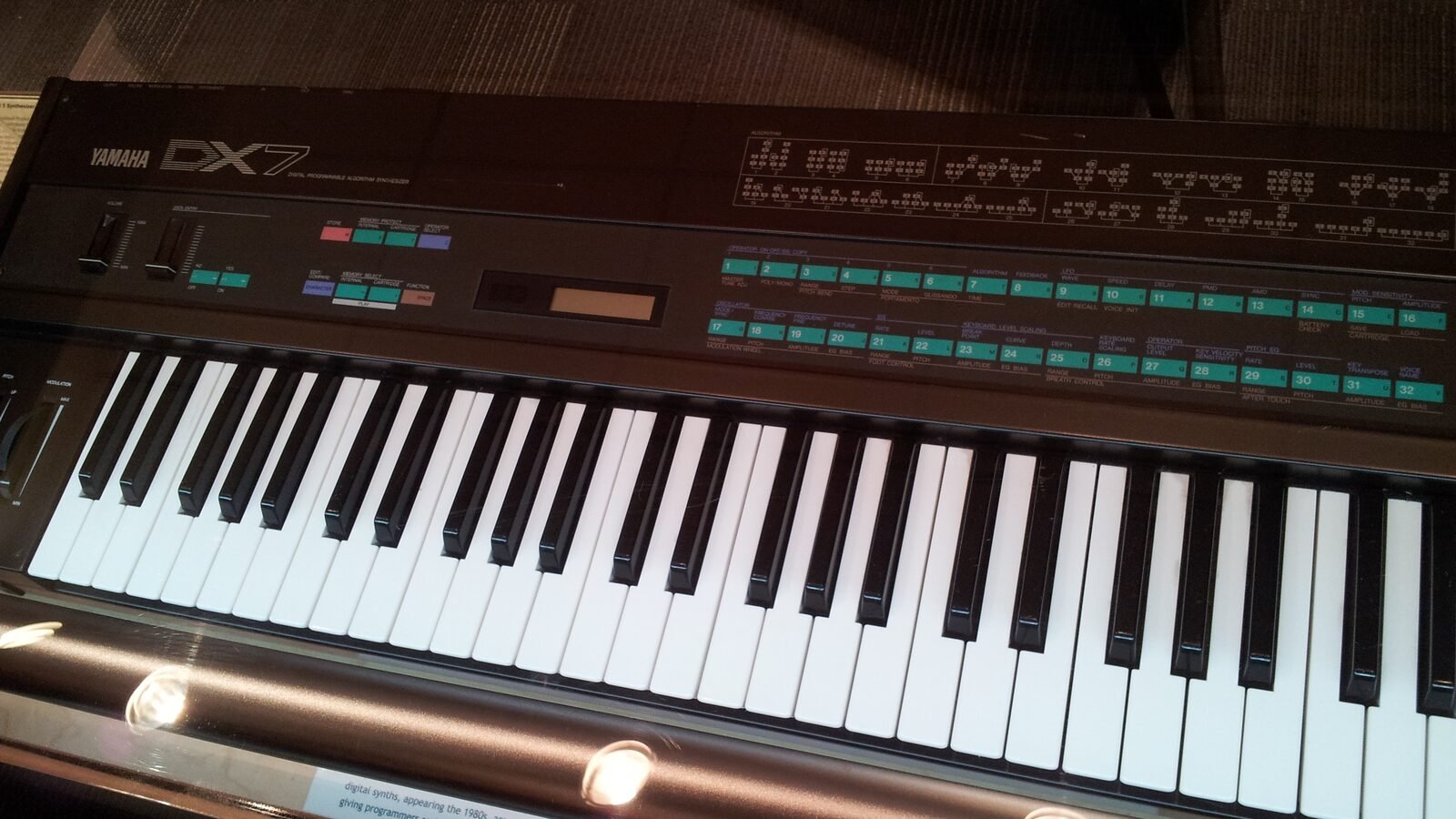
Yamaha put the DX7 on sale in 1983 for $1,995. One of its factory sounds, a bright electric piano called E.PIANO 1, went on to carry the slow songs of the decade, from Whitney Houston to George Michael.
The scale of it can be counted. Music theorist Megan Lavengood of George Mason University found the preset on around 40% of the singles that reached No. 1 on the US Billboard chart in 1986, as The Economist reported in 2020.
A digital synth at a working musician’s price
At launch the price was the story. The Economist wrote that at $1,995 the DX7 “held its own against keyboards six times the price”, at a time when a Fairlight CMI, launched in 1979, had cost $25,000.
The sound engine was frequency modulation, worked out by John Chowning at Stanford University and licensed to Yamaha, which secured exclusive rights in 1975. Yamaha’s own chips cut the hardware down to two, against 50 in its earlier GS1, and that brought the price down.
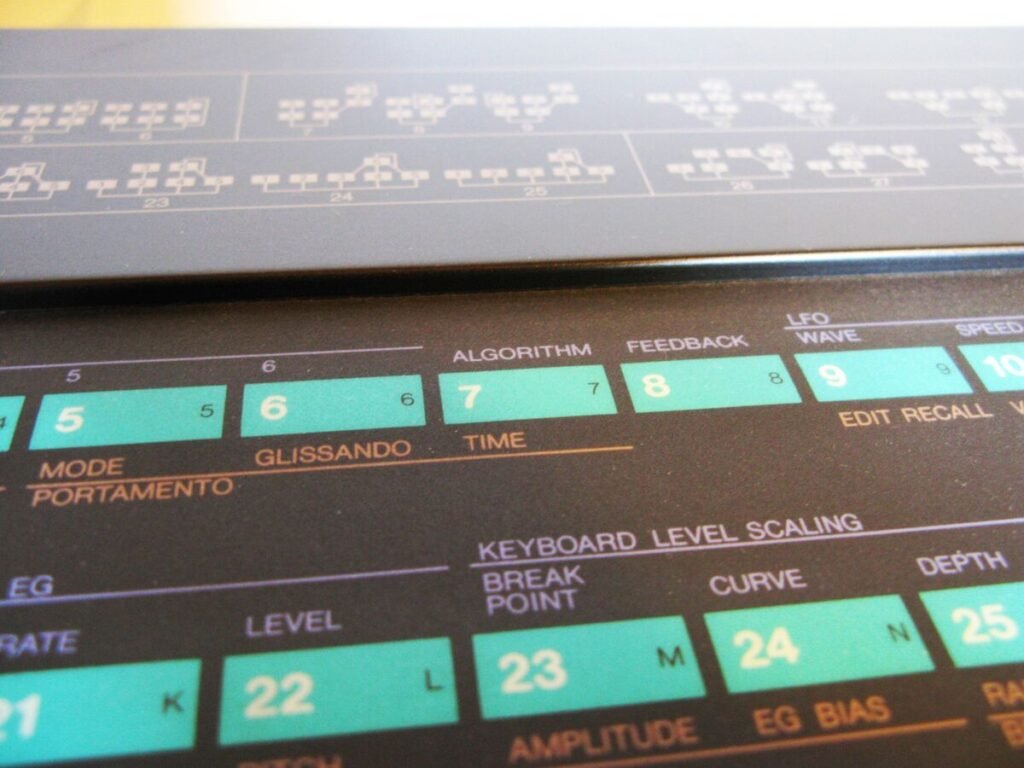
The spec sheet was new too: 16-note polyphony, 32 algorithms built from six sine-wave operators, the first LCD fitted to a synthesizer and the first patch memory that let players type in a name for each sound.
Synth historian Mark Vail told The Economist that Yamaha had found a “magic potion”. Buyers agreed, and the magazine puts sales at around 150,000 units over the four years the original model was in production, far more than any synth before it.
With no knobs, only membrane buttons and a small LCD, the DX7 was slow to edit, so most owners never programmed their own sounds and played the factory voices exactly as they came.
Those voices were made in a hurry. In his book The Synthesizer, Vail records that Dave Bristow and Gary Leuenberger, two specialists on Yamaha’s CS-80, had less than four days in late 1982 to program all 128 presets.
How one preset became the ballad sound
E.PIANO 1 is a digital stand-in for a Fender Rhodes, with a hard, glassy strike at the start of each note and a clean, bell-like fade that leaves plenty of room for a singer.
Writing in The Guardian in 2018, Dave Simpson called the DX7’s electric piano “the go-to songwriting tool for power balladeers for decades”. His example was Whitney Houston’s 1985 single “Saving All My Love for You”.
That record topped the Hot 100 on 26 October 1985 and won Houston the Grammy for Best Pop Vocal Performance, Female at the Grammy ceremony held the following February in Los Angeles.
The Economist named two more: George Michael’s “Careless Whisper” and Houston’s “Greatest Love of All”, which went to No. 1 on the Billboard Hot 100 on 17 May 1986 and stayed there for three weeks.
Lavengood set out her findings in the Journal of Popular Music Studies in 2019, in a paper whose title asks the question directly: “What makes it sound ’80s?”
The ubiquity came at a price. As early as February 1986, Electronics & Music Maker wrote that the DX7’s presets had been “plundered until there is no more originality to be gained from using them”.
Synthwave producers went back to the sound anyway, and we looked at the DX7’s place in Kavinsky’s outrun gear, and more 80s and 90s instruments are covered in our Synth Gear & Tech section.
Yamaha kept FM synthesis in its range after the DX7 was retired. In 2015 it released the Reface DX, a compact FM synth that carries the DX name on a much smaller keyboard.
Lavengood’s count did not stop at pop. In 1986, she found, E.PIANO 1 was also on 40% of country No. 1 singles and on 61% of that year’s R&B hits.
Lead photo: doryfour / Wikimedia Commons, CC BY-SA 2.0