

New Order released “Blue Monday” as a 12-inch single on Factory Records on 7 March 1983. It went on to become the best-selling 12-inch single in history, and the sleeve that came with it reportedly cost the label money on every copy.
In the UK alone the original 1983 pressing sold more than 700,000 copies, part of a total of 1.16 million UK sales across every version released by 1995, according to data from the Official Charts Company.
On the UK singles chart it peaked at only number nine. It kept selling for years afterward, spending 38 weeks in the chart’s top 75 and 186 weeks on the UK Independent Singles Chart, a run second only to Joy Division’s “Love Will Tear Us Apart.”
In New Zealand it reached number two and spent 74 weeks in the top 50 across three separate calendar years, the kind of long tail that turned a club record into a catalogue seller.
The track itself was mostly machine-made. Peter Hook’s bassline came from a Moog Source, the clattering intro from an Oberheim DMX drum machine, the same class of gear FCR covered in its piece on the Roland TR-808, a drum machine that also sold poorly when it was new, in that same year, before it defined a different genre.
A sleeve built to look like a floppy disk
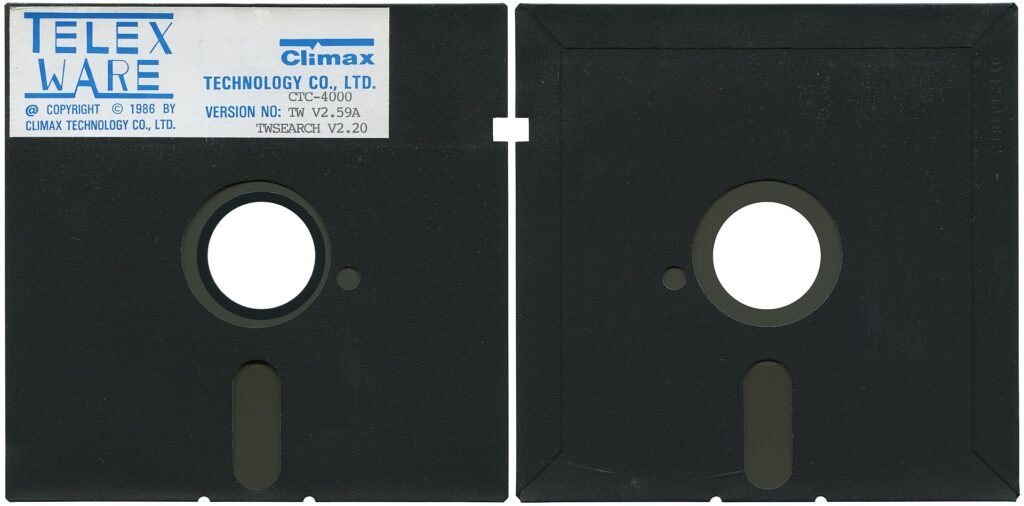
The 12-inch’s packaging, designed by Peter Saville and Brett Wickens, was die-cut to resemble a 5 1/4-inch floppy disk, with three holes cut through to a silver inner sleeve.
Saville first saw a floppy disk in New Order’s rehearsal room and asked drummer Stephen Morris what it was. He decided the only text on the front would be a column of colour-coded blocks, a cipher he invented himself for the words “FAC 73 Blue Monday and the Beach New Order.”
The artwork arrived so late that Saville sent it straight to the printer, unseen by the band or by Factory first. An invoice dated 14 July 1983 from Peter Saville Associates to Factory Records, preserved in the label’s archive, lists the design fee for “New Order ‘Blue Monday’ 12 inch FAC 73” at £538.20.
The 5p-a-copy story Peter Saville calls unlikely
Design historian Matthew Robertson wrote in Factory Records: The Complete Graphic Album that “due to the use of die-cutting and specified colours, the production cost of this sleeve was so high that the single sold at a loss.” Factory co-founder Tony Wilson told the same story for years, that the sleeve lost 5p on every copy, “due to our strange accounting system.”
Saville doubts it. In a 2013 Guardian interview he said Wilson “loved to say the sleeve was so expensive they lost 5p per copy. But it’s unlikely; Factory never talked budgets.”
Demand also outran the die-cutting line. Saville said the printers “banged out a cheaper version” partway through the run, a plain black sleeve with no holes cut, and that he still does not know how many copies went out that way.
By 2011, writing in Shadowplayers, James Nice quoted Saville saying he was “so bored with this story.”
AllMusic’s review still calls “Blue Monday” “the best-selling 12-inch single of all time,” and the Guardian used the same description in 2011, noting that the sleeve-cost story had become shorthand for “proof that some indie labels really did value art over commerce.”
New Order remixed the track twice. The 1988 version reached number three in the UK and topped the US dance chart; a 1995 remix also returned it to the UK top 20. FCR’s piece on Jan Hammer’s Miami Vice Theme covers another mid-80s synth production that reached number one in the US the same decade.
More on the design side of the era, including other Factory and Saville covers, is in FCR’s Retro Culture & Visuals section, and the hardware behind the hits is covered in Synth Gear & Tech. Both the 1988 and 1995 reissues came in plain card sleeves, with no die-cutting and no floppy-disk shape at all.
Lead photo: Luke Brehony / Wikimedia Commons, CC BY-SA 4.0