
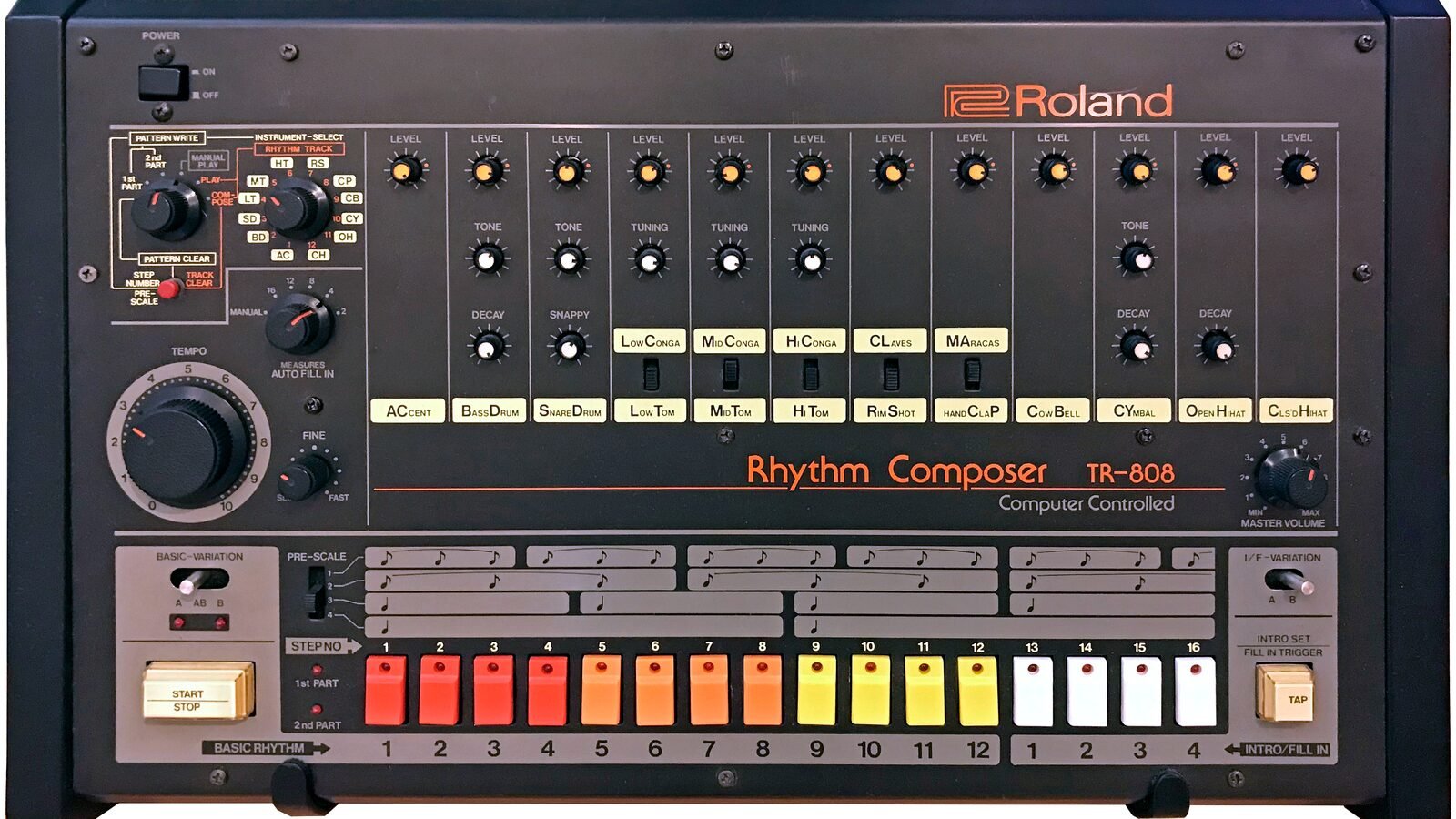
Roland launched the TR-808 Rhythm Composer in 1980 with a list price of $1,195. It sold fewer than 12,000 units and was out of production by 1983, a few years before it became the drum machine behind hip-hop.
The trouble at launch was the sound. Next to the Linn LM-1, which played recordings of real drums and cost $4,495, the 808 sounded thin and electronic, FACT magazine wrote in a 2014 history of the machine.
Not every early review was harsh. Contemporary Keyboard predicted in 1981 that the TR-808 would “undoubtedly become the standard for rhythm machines of the future”, because it could program an entire percussion track as well as single rhythm patterns.
Why the 808 sounded nothing like a drum kit
The 808 makes every sound with analog circuits, with no samples anywhere inside. TR stands for transistor rhythm, and its kick drum is a sine-wave oscillator with a decay control that lets each hit ring out into a long, low boom.
The design team was led by engineer Tadao Kikumoto. “The goal we could not reach with analog technology in 1980 was a Drum Synthesizer,” he told Roland’s own Roland Articles site in a 2020 interview.
Its step sequencer stored 32 patterns and could chain up to 768 measures, and a DIN sync port, a forerunner of MIDI, let it drive other machines in a studio or on stage.
Buyers wanted realism. FACT likened the 808’s mix of synth tones and white noise to “bursts coming from the BBC Radiophonic Workshop”, and says it was dropped in 1983 “thanks to poor sales and a reputation for sounding, well, weird”.
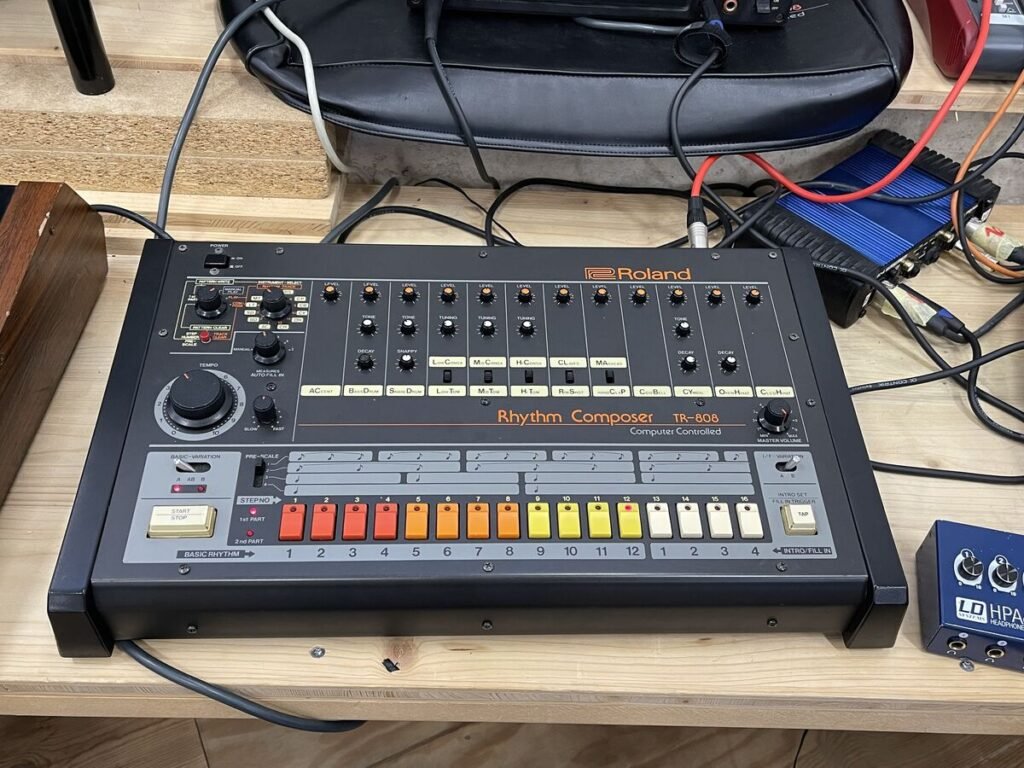
That failure created a glut of cheap units. By the time it was discontinued, FACT wrote, the 808 was “a regular fixture in junk shops and pawn shops” and easy to pick up for under $100.
From pawn shops to the centre of hip-hop
The first famous outing came in Japan. Yellow Magic Orchestra played it live in “1000 Knives” at Tokyo’s Nippon Budokan at the end of their 1980 world tour, and it then became a central part of the band’s 1981 album BGM, Roland notes.
Marvin Gaye’s “Sexual Healing” in 1982 was the first US hit single to feature the 808. The same year Afrika Bambaataa and the Soulsonic Force released “Planet Rock”, another early record built on its electronic beat.
It reached pop ballads too. The Independent lists Phil Collins’s “One More Night” next to “Sexual Healing” as slower hits that used the machine.
Run-DMC, LL Cool J and Public Enemy followed. “It’s not hip-hop without that sound,” Bomb Squad producer Hank Shocklee says in the documentary 808, as quoted by The New Yorker in 2015.
By 2015 the same magazine was calling the 808 the bedrock of the modern “urban-youth-culture soundtrack”, especially for trap artists who use its long kick as a bassline.
Kanye West used the 808 on every track of his 2008 album 808s & Heartbreak, and that December The Independent reported vintage units selling for over £1,000 on eBay, about 50 per cent more than the original price.
Synthwave owes the machine a debt too: the 808 is part of the toolkit in our breakdown of Kavinsky’s outrun gear, built around a Juno and a DX7 as well as the 808.
More drum machines and synths sit in our Synth Gear & Tech archive, and our guide to building outrun beats on the Akai MPK Mini IV covers programming drums from a small controller.
Roland came back to the design in 2017 with the TR-08, a smaller reissue, and Behringer released its own RD-8 clone in 2019.
Fans now mark 808 Day every year on 8 August, a date chosen because it is written 8/08 in the US format.
Lead photo: Bryan Pocius / Wikimedia Commons, CC BY 2.0