
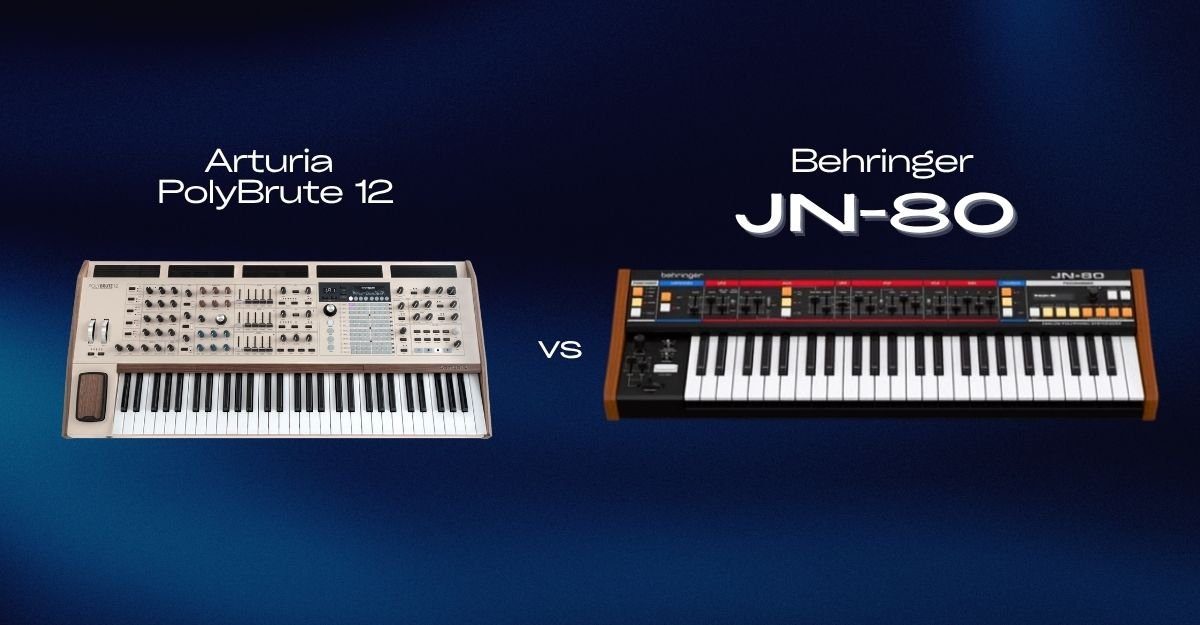
In 2026, the electronic music production landscape is split into two distinct philosophies. One camp demands relentless forward innovation—synthesizers that push the boundaries of physical expression and complex modulation. The other camp demands pure, unadulterated authenticity—a perfect, accessible recreation of the hardware that defined the 1980s.
Enter the two heavyweights dominating studio conversations this year: the Arturia PolyBrute 12 and the recently released Behringer JN-80.
While both are formidable polyphonic analog synthesizers, they serve entirely different masters. The PolyBrute 12 is an expressive, complex modulation monster, whereas the JN-80 is an 8-voice love letter to the legendary Roland Juno-60. If you are looking to anchor your studio with a new polysynth, understanding how these two approach sound design is critical.
The Arturia PolyBrute 12: The MPE Powerhouse
Arturia’s PolyBrute 12 is less of a traditional synthesizer and more of an acoustic-electronic hybrid. It was built for composers and sound designers who need their patches to live, breathe, and evolve beneath their fingertips.
The FullTouch MPE Keyboard
The defining feature of the PolyBrute 12 is its proprietary FullTouch® keyboard. Unlike standard MIDI keyboards that only track initial velocity and bottom-out pressure, FullTouch tracks the exact vertical position of every individual key in real-time. This allows for Polyphonic Aftertouch and Z-axis modulation that makes playing a synth pad feel like bowing a cello.
Dual Analog Architecture
Under the hood, it boasts 12 voices of polyphony driven by dual Brute oscillators. But the real magic happens in the filter section. Arturia equipped this beast with both a 12 dB/octave Steiner-Parker filter and a classic 24 dB/octave Moog-style Ladder filter. You can morph seamlessly between the two, creating complex, tearing swells that simply cannot be replicated by vintage hardware.
The Behringer JN-80: The Sweet-Spot Machine
For years, the synthwave community begged for a reliable, modern clone of the Roland Juno-60. With the release of the JN-80, Behringer finally delivered—but they supercharged it.
The 80s Just Evolved
The JN-80 utilizes a meticulously engineered signal path built around authentic Digitally Controlled Oscillators (DCOs) and period-correct 3109 VCF (Voltage Controlled Filter) chips. It sounds exactly like 1982. However, Behringer bumped the polyphony up to 8 voices (compared to the original’s 6), giving producers much more headroom for massive, lingering ambient chords.
The Legendary BBD Chorus
You cannot make synthwave without the classic Juno chorus, and the JN-80 perfectly replicates the iconic multi-stage BBD (Bucket Brigade Device) chorus. Pushing a simple square wave through this chorus instantly yields the lush, wide, and melancholic pads made famous by artists like Timecop1983 and FM-84.
Instead of Menu-diving, the JN-80 gives you immediate, knob-per-function tactile control, making it the ultimate “sweet-spot” synthesizer. It is almost impossible to make it sound bad.
Interactive Spec Breakdown
Before making a significant investment for your studio, use this interactive comparison tool to filter through the technical architectures of both synthesizers to see which workflow matches your production style:
| Feature | Arturia PolyBrute 12 | Behringer JN-80 |
| Polyphony | 12 Voices | 8 Voices |
| Oscillators | Dual Analog VCOs | Authentic DCOs (Juno Replica) |
| Filters | Steiner-Parker & Ladder (Dual) | Period-Correct 3109 VCF |
| Keyboard | FullTouch MPE (Z-axis tracking) | 49-Key with Standard Aftertouch |
| Onboard FX | Modern Digital FX Suite | Authentic Analog BBD Chorus |
| Modulation | Deep Matrix & Morphée 3D Controller | Classic LFO & Envelope Setup |
| Primary Workflow | Complex Sound Design & Morphing | Immediate “Sweet-Spot” Tweaking |
| Best For | Cinematic Scoring & Avant-Garde | Pure 80s Synthwave & Retrowave |
Key takeaway: Choose the Arturia if your music relies on complex, evolving, cinematic sound design and intricate physical performance. Choose the Behringer if you want immediate, mix-ready retro tone and the unmistakable nostalgic warmth of the 1980s.
Frequently Asked Questions (FAQ)
Is the Behringer JN-80 an exact clone of the Roland Juno-60?
The JN-80 is an incredibly faithful reproduction of the Juno-60’s core analog architecture, utilizing period-correct 3109 filter chips. However, it features modern quality-of-life upgrades including 8-voice polyphony, comprehensive MIDI implementation, and 400 preset memory slots.
Does the Arturia PolyBrute 12 support MPE?
Yes. The PolyBrute 12 features Arturia’s patented FullTouch® keyboard, which provides full MPE (MIDI Polyphonic Expression) capabilities. It tracks the exact vertical position of every key, allowing for unprecedented expressive control over patches.
Which synthesizer is better for Synthwave production?
While both are excellent, the Behringer JN-80 provides the immediate, authentic 1980s tone (including the iconic BBD Chorus) that serves as the foundation for the synthwave genre. The PolyBrute 12 is better suited for producers looking to push beyond traditional 80s sounds into modern cinematic scoring.
As part of Future City Records‘ ongoing mission to bridge the gap between 1980s nostalgia and modern electronic production, our hardware spotlights break down the tools defining the current sound of synthwave, darksynth, and outrun.
3 thoughts on “2026 Hardware Spotlight: Arturia PolyBrute 12 vs Behringer JN-80”
Comments are closed.