
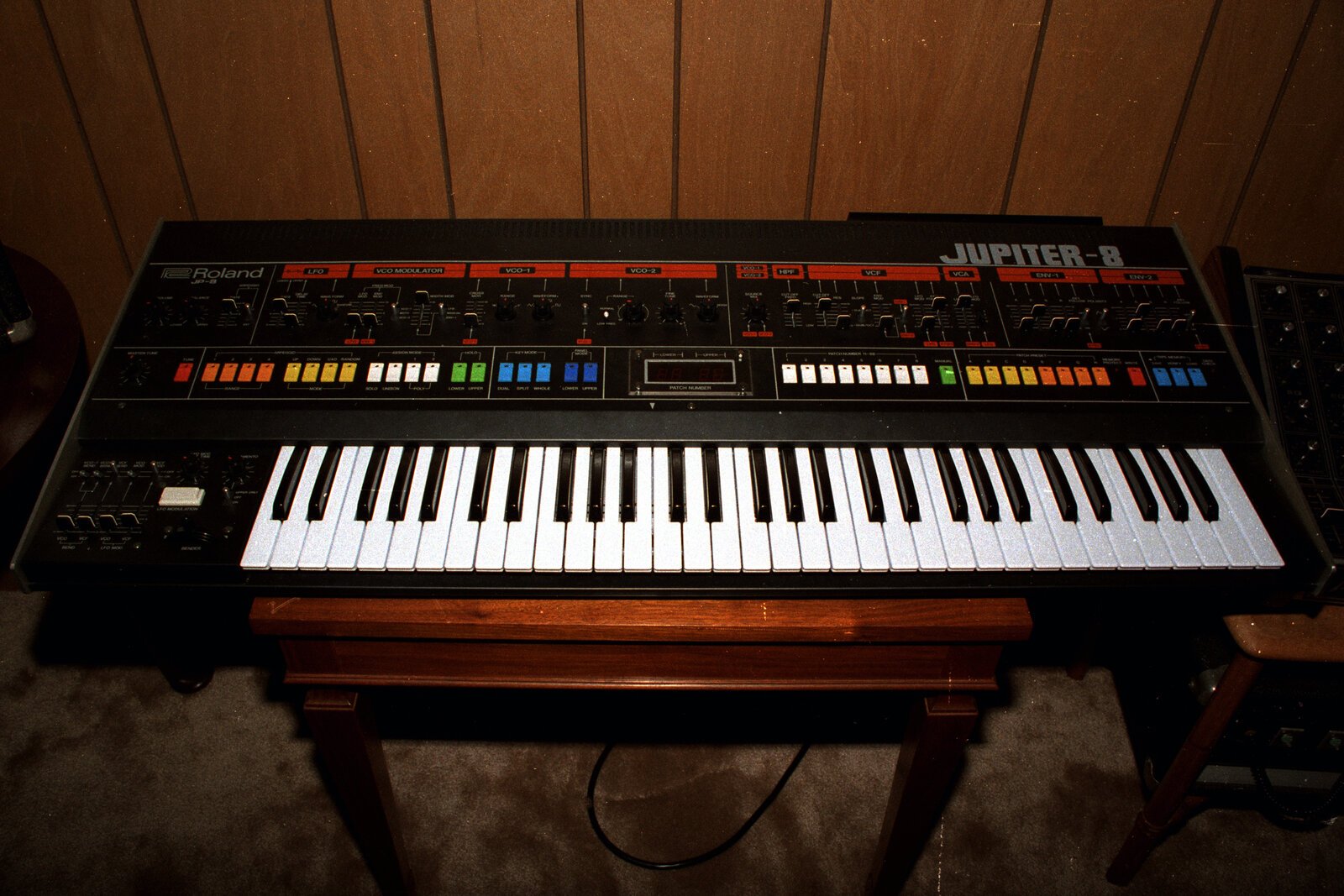
Roland put the Jupiter-8 on sale in early 1981 for $5,295 in the US, ¥980,000 in Japan and £3,995 in the UK.
That price bought an eight-voice analog synthesizer with 61 keys and storage for 64 patches, two years before Yamaha’s DX7 undercut the category at $1,995. The Jupiter-8 stayed Roland’s flagship synthesizer for the next four years, through most of the period that later gave synthwave its sound palette, and it still sat well below the £15,000 starting price of a 1979 Fairlight CMI sampler.
Eight voices, two zones, one keyboard
Each of the eight voices ran two separate VCOs, for 16 oscillators in total, into a resonant low-pass filter switchable between 12 and 24 dB per octave. A separate, non-resonant high-pass filter and a single LFO offering triangle, square, sawtooth or random waveforms rounded out each voice.
The keyboard split into two zones, Upper and Lower, each carrying its own patch through its own output. Few rival synths offered that in 1981, and the Jupiter-8 could also sync its arpeggiator to outside gear through Roland’s proprietary DCB interface and CV jacks on the rear panel.
A rarer trick was the polyphonic unison mode, stacking all 16 oscillators onto one note and dividing them back down automatically as more notes were added.
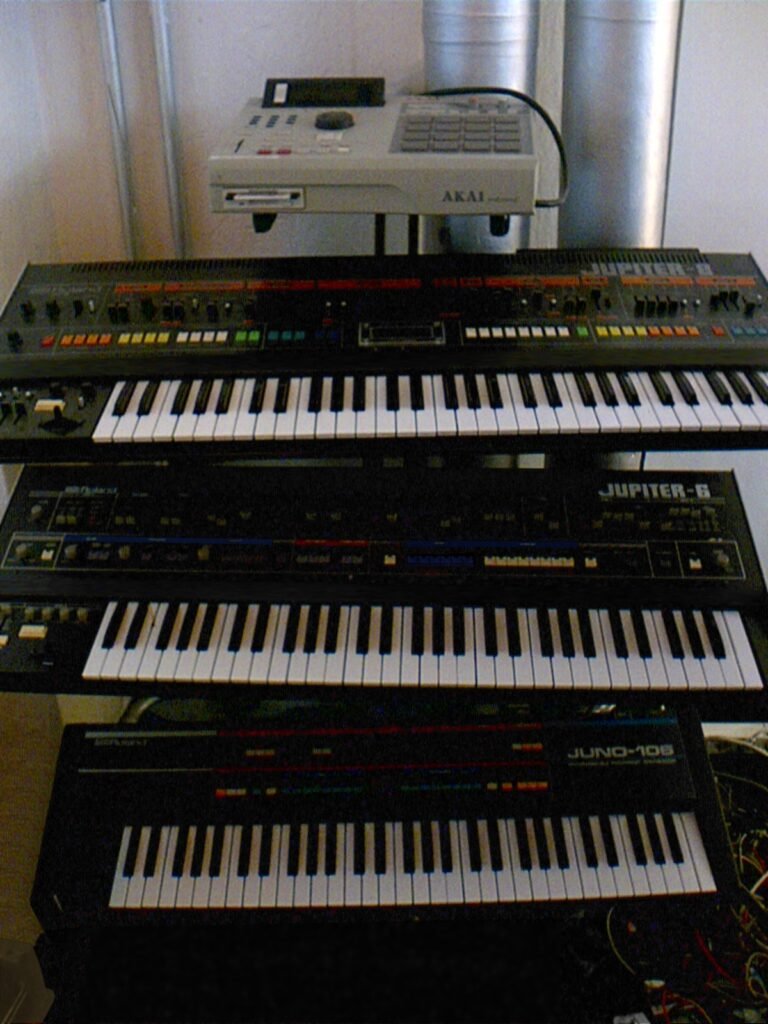
Early units had unstable tuning, traced to a 12-bit digital-to-analog converter on the interface board. From serial number 171700, Roland switched to a 14-bit DAC, and later production runs added brighter display LEDs and a standard DCB port.
Roland built roughly 3,300 Jupiter-8 units before retiring the model in 1985, according to the synth’s production history. The keyboard had no velocity sensitivity or aftertouch, unlike the MIDI synths that followed it a few years later.
Who played the Jupiter-8 in 1982
Duran Duran recorded the signature arpeggio on “Hungry Like the Wolf,” from 1982’s Rio, on a Jupiter-8.
Michael Jackson’s “Thriller,” also from 1982, opens with synth blasts from a Jupiter-8 run in double four-voice mode, the mod wheel opening the filter as the note builds.
Marvin Gaye brought a Jupiter-8 and a TR-808 into Studio Katy outside Brussels in December 1981 to record “Sexual Healing.” Engineer Mike Butcher told Electronic Sound the song was among the first four tracks Gaye cut there, after moving to Belgium amid a collapsing deal with Motown.
In Bombay the same year, session musician Charanjit Singh paired a Jupiter-8 with a TR-808 and a TB-303 for Ten Ragas To A Disco Beat, recorded in two days, he told The Guardian in 2010. The record predates Phuture’s “Acid Trax,” usually credited as acid house’s first release, by five years, and was reissued after collector Edo Bouman found a copy in a Delhi record shop in 2002.
Vince Clarke kept a Jupiter-8 in his home studio decades after its release, listed alongside dozens of other analog synths in a 2012 Keyboard magazine feature on his collection.
What one costs now
An original 1981 Jupiter-8, described by its seller as being in “time capsule condition,” listed on Reverb for $27,996 in December 2024, MusicTech reported. The price had already been cut 20% from its usual asking figure for that condition.
Roland sells a cheaper route into the sound today. The 2015 Boutique JP-08 reuses the Jupiter-8’s circuit behavior in a pocket-sized unit, but with four voices instead of eight, half the original’s polyphony.
A fuller recreation, with the Jupiter-8’s full eight voices, shipped as a plug-out bundled standard with Roland’s System-8 synthesizer in 2017, three years before Roland revived the Jupiter name again on the fully digital Jupiter-X and Jupiter-Xm keyboards. Producers chasing that sound on a budget still reach for those, alongside more vintage synth gear in our archive.
Lead photo: Ed Uthman / Wikimedia Commons, CC BY-SA 2.0