

“One of the rarest synthesizers ever made” is how Cherry Audio describes the Gleeman Pentaphonic, a five-voice polysynth from 1981. The company says fewer than 70 were ever built.
Cherry Audio, a plugin developer in California, released a software version this month for $59.
A used original can cost up to $5,000, according to MusicRadar, on the rare occasions one turns up.
A synth from a Mountain View garage
The Pentaphonic was built by two brothers, Bob and Al Gleeman, in a garage in Mountain View, California, in the early 1980s, while Silicon Valley was busy with personal computers. Al, an electrical engineer, designed it, and Bob, a musician, ran the business.
“Some synthesizers become classics because they were everywhere. The Gleeman Pentaphonic became one because it almost wasn’t anywhere at all,” Cherry Audio writes in the plugin’s manual.
Bob wanted the sound of the new programmable polysynths in something he could carry.
The first model came in a plain black case with a handle and a built-in speaker, and weighed 18 pounds. It also had a 300-note polyphonic sequencer and a joystick for pitch.
It had five voices with three digitally controlled oscillators each, 15 in all, so it stayed in tune under stage lights. The filter was a Curtis CEM3320, the chip also used in the Prophet-10 and the Oberheim OB-8.
Each oscillator had eight waveforms, including two “complex” ones that Cherry Audio says gave bright, bell-like overtones years before the DX7 made FM synthesis famous.
At under $3,000 it was pitched against the Sequential Prophet-5, which Cherry Audio puts at $4,600. The brothers built around 30 of the black units by hand.
A see-through model for the stage
The second model, the Pentaphonic Clear, came in a transparent acrylic case with plexiglass knobs and optional lighting, so the audience could see the green circuit boards glow. A remote power supply kept the weight down, and a two-axis joystick handled pitch and modulation at the same time.
It had a shoulder strap and a 20-foot cable, which made it a keytar, plus 100 patch memories and a 600-note sequencer. Fully loaded, it cost about $3,400. Fewer than 20 Clears were built.
Sales did not last. “It went out of production in 1983,” Sonicstate reported, adding that some put its rarity down to timing: it arrived just as the Yamaha DX7 came out. In 1994, David Kean of the Audities Foundation bought the brothers’ leftover parts and assembled a small final batch, reportedly seven Pentaphonics and seven Clears.
Oscar Peterson played it for two hours
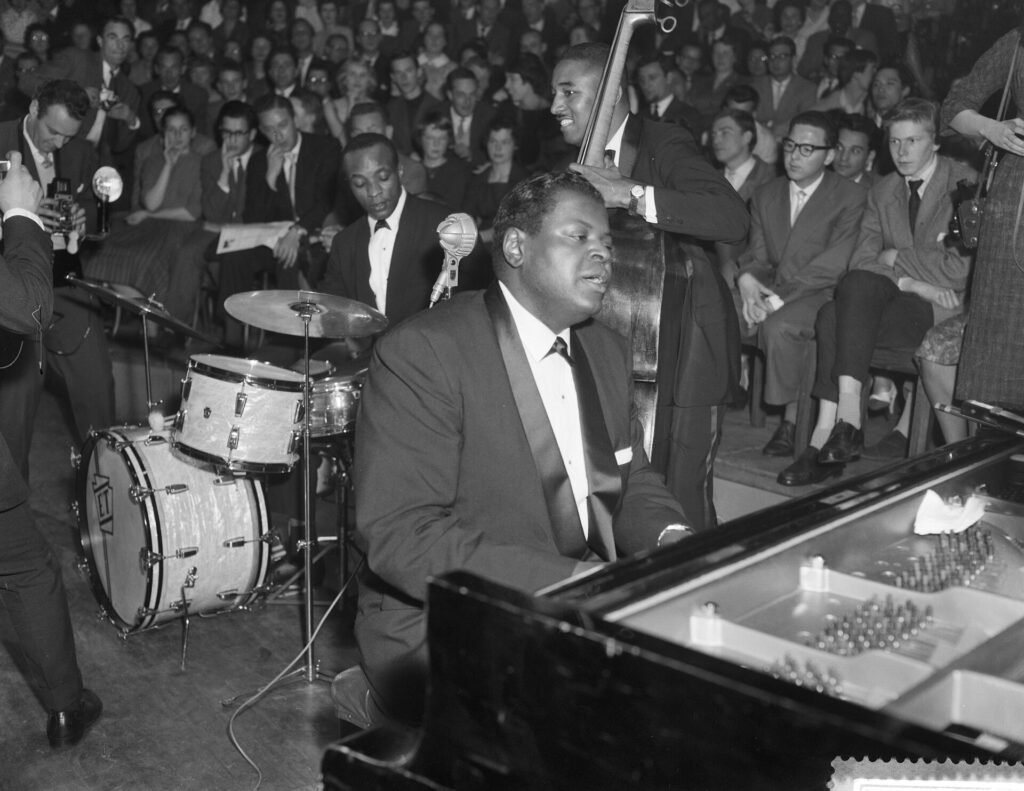
The jazz pianist Oscar Peterson tried one in a music shop in the San Francisco area. He reportedly played it for about two hours and then bought it.
Cherry Audio says R.E.M., Kansas and The Band used the Pentaphonic, that the songwriter Kevin Gilbert played one on the album NRG, and that Depeche Mode’s Martin Gore owns one.
The plugin keeps all eight original waveforms and adds what the hardware lacked, such as oscillator sync and pulse-width modulation, with up to 16 voices. It is based partly on an unreleased 1983 successor that was meant to have eight voices, 61 keys and MIDI. There is also an arpeggiator, a polyphonic step sequencer, 22 effects from reverb to ring modulation, and three interface themes based on the original’s looks.
It runs on macOS and Windows as AU, VST, VST3 and AAX. For more synth money stories, read what a Roland Jupiter-8 is worth now, how Vangelis’s Yamaha CS-80 set a record, and how the Yamaha DX7 took over the 80s.
The original’s 37-note keyboard had no touch sensitivity, which some players found limiting, while the plugin responds to velocity and aftertouch.
Lead photo: Pete / Wikimedia Commons, CC BY 2.0